







Why Choose Flutter? The Pros and Cons of Building Cross-Platform Apps

Wondering if Flutter is the right choice for cross-platform app development? Discover the pros and cons of Flutter, compare it with React Native, Xamarin, and Ionic, and learn why it could be ideal for your business.

Table of Contents

Speed Is an Architecture Decision

Time-to-market is often framed as a delivery issue. For leadership, it is more so an architecture decision.

Organizations slow down when platforms are hard to change, releases require leadership sign-off at every step, or early design choices limit later decisions. In these situations, speed is limited not by execution effort, but by the cost of change. Cloud architecture affects time-to-market by lowering that cost and allowing business priorities to be acted on without structural delays.

When cloud foundations are designed with intent, releases shift from infrequent, high-risk events to smaller, predictable updates. Changes can be introduced without reworking core systems, which gives leadership clearer timelines and the ability to respond to market or customer signals without disrupting ongoing operations.

Faster Releases Through Better Risk Management and Consistency

Cloud architecture also reshapes how risk is managed. Performance, scalability, and reliability issues are identified earlier in the lifecycle, when they can be resolved without last-minute trade-offs. This reduces late-stage surprises and makes launches more controlled, rather than compressed under pressure.

As organizations scale, speed alone is insufficient. Consistency becomes a leadership requirement. Cloud-based platforms enable common delivery patterns across teams and regions, reducing dependency on individual execution styles. For CXOs, this translates into greater predictability across initiatives, better portfolio-level planning, and fewer delivery escalations.

Yugensys View: Architecture Aligned to Business Outcomes

In practice, Yugensys has seen time-to-market improve when architectural choices are made with business outcomes in mind, not treated as mere implementation. Across product launches and modernization programs, this has typically resulted in:

    • Platforms structured to validate direction early, allowing leadership teams to confirm priorities before committing significant time or capital

    • Existing systems updated in specific high-impact areas, so releases become faster and more predictable without disrupting stable operations

    • Cloud foundations built to support growth when it occurs, rather than forcing premature investment

    • Cloud architecture does not guarantee speed. But when aligned with business priorities, it removes many of the reasons products fail to reach the market on time.

At Yugensys, this alignment is treated as a discipline – one that helps leadership teams move with confidence, not urgency.

Our Services

Book a Meeting with the Experts at Yugensys


Subscrible For Weekly Industry Updates and Yugensys Expert written Blogs


More blogs from Data Infrastructure

No description found for this category.

Why Choose Flutter? The Pros and Cons of Building Cross-Platform Apps

Wondering if Flutter is the right choice for cross-platform app development? Discover the pros and cons of Flutter, compare it with React Native, Xamarin, and Ionic, and learn why it could be ideal for your business.

Table of Contents

Introduction

In today’s mobile-first world, building applications that work seamlessly across multiple platforms has become a top priority for businesses. Cross-platform frameworks like Flutter, React Native, Xamarin, and Ionic have made this possible, allowing developers to write code once and deploy it on both Android and iOS. But with so many options available, how do you know which one is right for you?

This article dives deep into Flutter, Google’s open-source UI toolkit, and compares it with other popular cross-platform frameworks. By the end, you’ll understand Flutter’s strengths and weaknesses and why it might be the best choice for your next app development project.

Flutter vs. Competitors at a Glance

Feature Flutter React Native Xamarin Ionic
Programming Language Dart JavaScript C# JavaScript/TypeScript
Performance High (native compilation) Moderate (uses JavaScript bridge) High (compiles to native) Moderate (webview-based)
Hot Reload Yes Yes Limited Yes
UI Consistency Consistent on both platforms Depends on platform components Near-native on both Web-based styling
Community Support Growing rapidly Large and active Strong in .NET community Large and active

Why Choose Flutter?

Consider a simple grid-based environment where a robot must navigate from a start position to a goal position. The grid contains obstacles that the robot must avoid. The robot is equipped with sensors that provide information about its surroundings, such as the presence of obstacles in adjacent cells.

The goal is to build a knowledge-based agent that can successfully navigate the grid from the start to the goal, avoiding obstacles, by reasoning about the environment based on its sensory inputs.

Key Differences

1. Programming Language

  • Flutter: Allows developers to write code in a single language, Dart, which eliminates the need to learn multiple languages like HTML, JavaScript, or CSS.
  • React Native: Built on JavaScript, making it a popular choice for web developers.
  • Xamarin: Uses C#, aligning well with the .NET ecosystem.
  • Ionic: Based on JavaScript and TypeScript, with a focus on web technologies like HTML and CSS.

2. Performance

  • Flutter: Delivers native app performance at 60 FPS, providing a smooth experience across platforms.
  • React Native: Relies on a JavaScript bridge, which can introduce slight lags in complex apps.
  • Xamarin: Compiles to native code, but app sizes can be larger.
  • Ionic: Utilizes a webview, limiting performance in highly interactive apps.

3. UI Consistency

  • Flutter: Provides a layered architecture that gives precise control over UI elements, resulting in pixel-perfect designs and seamless animations.
  • React Native: Uses platform-specific components, which may lead to visual differences.
  • Xamarin: Leverages native UI elements for a familiar look but may lack consistency across platforms.
  • Ionic: Uses web styling, which may not look as native as Flutter or Xamarin apps.

4. Hot Reload

  • Flutter: Supports hot reload, allowing developers to see changes instantly and enhancing productivity.
  • React Native: Also supports hot reload, though it may experience more glitches.
  • Xamarin: Limited hot reload capabilities, mainly in Xamarin.Forms.
  • Ionic: Offers hot reload, beneficial for frontend development.

Our Services

Book a Meeting with the Experts at Yugensys


Real Reasons to Choose Flutter?

Flutter offers several advantages that make it a powerful choice for cross-platform app development:

  1. Unified Language: With Dart, Flutter enables developers to write all code in one language, simplifying the development process.
  2. Type-Safe Coding: Dart’s type-safe structure reduces runtime errors and enhances reliability.
  3. Beautiful User Experiences: Flutter’s widget library allows for customized, pixel-perfect designs with precise control over UI elements.
  4. Quicker Prototyping: Every element in Flutter is a widget, allowing developers to prototype faster without extensive coding.
  5. Hot Reload: Flutter’s hot reload feature accelerates development, reflecting changes in real-time.
  6. Native App Performance: With consistent 60 FPS performance, Flutter provides a smooth user experience on both iOS and Android.
  7. Build & Release Automation: Flutter includes robust command-line tools for efficient app building and release management.

When to Hire a Flutter Developer

Hiring a Flutter developer comes with several benefits:

  • Dart Expertise: Flutter developers are skilled in Dart, which enhances development efficiency.
  • UI/UX Design Skills: They create visually stunning interfaces using Flutter’s extensive widget library.
  • Rapid Prototyping: With Flutter’s widget-based approach, developers can quickly prototype and iterate on app designs.
  • Hot Reload Proficiency: Flutter developers leverage hot reload for real-time adjustments and quick bug fixes.
  • Optimized Performance: Hiring Flutter developers ensures optimal app performance across both platforms.
  • Build & Release Automation: They efficiently utilize Flutter’s command-line tools for streamlined app deployment.

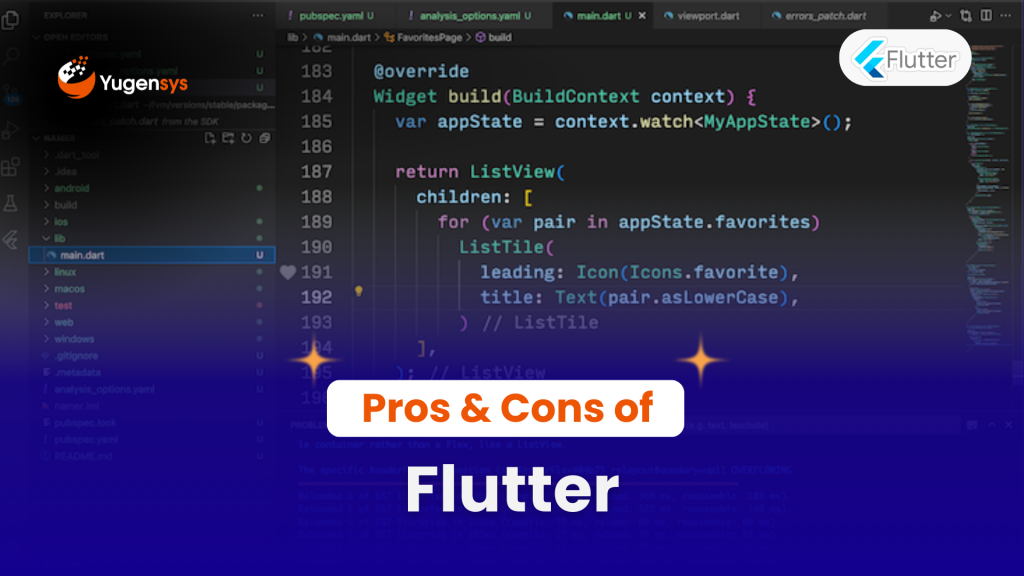
Pros and Cons of Flutter

Pros

  • High Performance: Achieves near-native speed by compiling to ARM code for iOS and Android.
  • Rich UI Components: Flutter’s customizable widgets enable pixel-perfect design and animation.
  • Single Codebase: Reduces development time and costs by allowing code reuse across platforms.

Cons

  • Learning Curve with Dart: Some developers may face an initial learning curve with Dart.
  • Library Limitations: While expanding rapidly, Flutter’s library ecosystem is still growing.
  • Larger App Sizes: Flutter apps may be larger due to the bundled framework components.

Yugensys’s Perspective on Flutter

At Yugensys, we recommend Flutter for cross-platform projects that demand high performance and a seamless user experience. Our Flutter developers are proficient in using its advanced features, ensuring that your app not only functions flawlessly but also offers a visually captivating experience.

Conclusion

Flutter stands out as an excellent choice for businesses looking to create cross-platform apps with high performance and a consistent user experience. While other frameworks like React Native, Xamarin, and Ionic have their strengths, Flutter’s unified language, robust performance, and hot reload feature make it a top choice for many projects.

If you’re interested in building a high-quality cross-platform app, Yugensys can help you harness the power of Flutter. Reach out to us today to explore how we can turn your vision into reality.

Vaishakhi Panchmatia

As the Tech Co-Founder at Yugensys, I’m driven by a deep belief that technology is most powerful when it creates real, measurable impact.
At Yugensys, I lead our efforts in engineering intelligence into every layer of software development — from concept to code, and from data to decision.
With a focus on AI-driven innovation, product engineering, and digital transformation, my work revolves around helping global enterprises and startups accelerate growth through technology that truly performs.
Over the years, I’ve had the privilege of building and scaling teams that don’t just develop products — they craft solutions with purpose, precision, and performance.Our mission is simple yet bold: to turn ideas into intelligent systems that shape the future.
If you’re looking to extend your engineering capabilities or explore how AI and modern software architecture can amplify your business outcomes, let’s connect.At Yugensys, we build technology that doesn’t just adapt to change — it drives it.


Subscrible For Weekly Industry Updates and Yugensys Expert written Blogs


More blogs from Mobile App Development

Dive deep into the ever-evolving field of mobile app development, encompassing tools, frameworks, and techniques to create seamless, engaging experiences for iOS and Android platforms. This category covers everything from UI/UX design and performance optimization to integrating advanced technologies like AI, AR, and cloud services into your apps, empowering developers to stay ahead in a competitive digital landscape.


Expert Written Blogs

Common Words in Client’s testimonial